Tuesday, March 29, 2011

Chicisimo.com

I am continuing in giving account of IE Managing Technology Start-Ups classes. This time IE hosted Gabriel Aldamiz-Echevarria, serial entrepreneur with experience from the Silicon Valley, who talked about his latest project Chicisimo. The whole idea started as Gabriel and his wife revealed a group of girls, who took a picture of them every morning to share how they will be dressed that day. They posted their pictures on Flickr and hence generate traffic to their profile pages. Gabriel was thinking how to leverage this idea and eventually came up with a photo sharing platform dedicated to fashion.

Chicisimo pics

The users of Chicisimo are fashion conscious girls some of them perhaps wannabe models with 17-25 years living in large urban areas. I have spotted large concentration of users from Spain, but they are also plenty of them from the UK, USA, Germany and the rest of the developed world. Currently, there are not many users from the fashion metropolises of Japan and China, most likely due to the language limitation. This is fact is a bit disturbing as the new fashion trends are more and more being created in Asia. Hence, capturing Asian market would create interesting synergy and source of inspiration for the users.

Gabriel is exploring more ways to monetize the platform in the future. At the moment, he focuses on expanding the user base in order to create sizeable community. The monetization could come in various ways. I can think of following revenue streams:

  • Generating leads to Fashion Web Shops
  • Selling advertising space
  • Promoting certain brands via campaigns (e.g. picture yourself with anything from Burberry and win …)
  • Selling statistics / reports about fashion trends and market development

Indeed, the market seems to be very promising as number of fashion buyers at the web ranked second in Europe in 2010 (Nielsen). Moreover, the online fashion shops market in the USA amounted $30b in 2010 and fashion advertisers spent $4b in 2009 on ads in US printed journals (Forrester and Magazine Publishers of America).

I think that Chicisimo is on promising path to success. The feature, which is now painfully missing at the platform is existence of a comprehensive regularly updated fashion product catalogue. With such a catalogue, user would not only identify the brand she wears, but a particular product, which would be linkable to the web shop generating lead revenue for Chicisimo. On the other hand, I understand that creating such a catalogue means entering into negotiation with more than 400 brands that are currently represented at Chicisimo so that time will be needed.

In conclusion, Gabriel needs to attract four groups of people to make Chicisimo a success users, fashion brands, fashion journalists, and investors. You need to have a great product to create a community of users. However, users do not directly influence corporate fashion brands, journalists or investors so that with users Gabriel is still half way through.

Thursday, March 24, 2011

New Cars with Discount over Internet

I read that selling cars is referred as “a sucker’s market”, because car dealers wait for a “sucker”, on whom they can score. Away from urban tales, George A. Akerlof received a Nobel Prize in Economics for studying the market for lemons, where he referred to used cars market as an typical example of trading lemons. The theory in a nutshell says that owners of good cars keep them and owner of lemons place them at the market. As customers cannot distinguish between good cars and lemons, they are not willing to pay the fair price for a good car, hence pricing all cars as average at the market. As a result, owner of good cars do not sell their cars at the market, where only over priced lemons remain.

That is probably one of the reasons, Iñaki Arrola, founder of autodescuento.com and coches.com started its website with new cars only. The business model is following:

1. Contracted car dealers enter their stock cars to the web page

2. Customer searches for a new car based on her criteria

3. Customer sees only models and prices without disclosing the dealer’s identity

4. After filling out the request form, customer gets into contact with dealer

5. Coches.com receives commission from sales. Additionally, coches.com can contract insurance or financing for the car with commission as well.

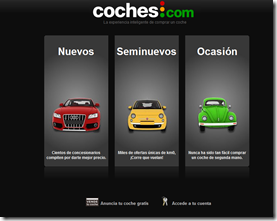
The process is very easy for both dealers and customers. Dealers just select car model and set desired discount from the official list price. Customers enjoy very intuitive interface with option to specify car they want based on “human” terms like “small” or “big” etc. All the photos and car presentation is very professional, informative, but not overwhelming. Iñaki claims inspiration with Apple design philosophy of simplicity and usability.

coches

The advantage of new cars over the used one is absence of the lemon issue mentioned in the beginning. Moreover, new car itself of the same model is de facto a commodity without a difference for customer from whom she buys. Therefore at coches.com, dealers compete with each other only on price without possibilities for differentiation with services etc. Unlike at German competing site mobile.de, dealers cannot put their address or contact number to the site so that they are fully “enveloped” in the platform. What about car manufacturers, do they like these two sided platforms between customers and car dealers. Not at all. As, Iñaki mentioned during the presentation, car manufacturers pretend they do not know as such platforms destroy their regional distribution model. At coches.com any dealer from any part of Spain can sell to customers anywhere, which substantially increases competition and eventually will push down prices for new cars.

Tuesday, March 22, 2011

Workshop on Raising Capital with Jorge Mata

On 21.03.2011 successful Spanish origin entrepreneur Jorge Mata in the mobile industry held a workshop with IE Business School students about founding start-up and getting funding. These are short notes from the workshop. You can find tweet stream from the workshop here.

  • Features of the business ideas to be attractive to investors:
    • Scalable & Disruptive
    • Contain real process that solves a real problem
    • Management team - CEO, CFO, COO, Sales Director, who are working in the company
    • Good credentials of the founders

Jorge is building on the experience from his past whenever evaluates a new idea. Which experience from the past and knowledge he possesses can be leveraged in the idea.

  • Remarks about raising capital to the venture
    • Venture Investor diversifies by investing to multiple ventures. On the other hand Entrepreneur must focus on product not decreasing risk by further diversification within the venture. Hence, Investing Entrepreneur's own funds to the venture is not recommended by Venture Investors.
    • Do not differentiate among investors, money is green everywhere.
    • You have to create a spiral of investment. Majority of investors do not invest unless somebody did that before. Think to whom you will talk as first, second, etc.
    • At the beginning - give away max. 30% of the company


Jorge share with us his insights about dealing with different types of investors.

  • Angels
    • Be careful in nurturing relationship with them. Angels invest in you rather than into company. There is more into the relationship than what is in the contract.
    • Expected outcome for an Angel Investor 20X as they invest in early stages.
    • Angels usually invest around $0.5 mil.
  • Venture Funds
    • Maintain formal and informal Quarterly / monthly communication.
    • Investors use a big chunk of entrepreneurs to learn from them rather than with interest to invest.
    • As an Entrepreneur, achieve at least $2-3 mil. pre-money valuation to be in good negotiating position before exiting from the venture. With valuation of $0.5-1 mil. you will have difficult time to extract money.
  • Venture Governance
    • Board of Directors - equity investors representatives
    • Advisory Board (optional) - board of experts or well connected persons
    • Get a local CEO in local country esp. at emerging markets

At the end, Jorge made few remarks about the current hot trend in mobile applications.

  • Few mobile applications are solving a real problem
  • Most of the company value is making things simple to the user and solving a real problem rather than possessing superior technology.
  • Currently, there are thousands of patents unused e.g. in Bell Labs

Sunday, March 20, 2011

WeblogsSL–Impressions from Session with Julio Alonso

weblogs-sl
Let’s start with some facts about the WeblogsSL. It is the first company in Europe in vertical publications with more than 40 blogs and 15.8 million unique visitors in January 2011. The Madrid based company was founded in January 2005 by charismatic entrepreneur Julio Alonso, who gave up his successful consulting career to start this enterprise. Initially, the founding team was working from Julio’s bedroom with zero outside funding. Julio surrounded himself with passionate bloggers, subject matter experts for particular topic, who write deep, insightful and interesting posts about the topic they like. There lies the main difference between WeblogsSL and traditional media, where journalists are usually “generalists” assigned to topic by the chief redactor. Additionally, on-line community of readers actively comments on blog posts and correct even slightest errors or omissions, powerful feedback mechanism most WeblogsSL’s competitors lack.
Chart picture
WeblogsSL’s product is the content it generates and publishes for free at the Internet. Quality, frequency of updates and the topic of the content is what determines how many readers it attracts. However, are WeblogsSL’s readers its customers? Given the fact that the content is for free, the answer is clearly no. Producing the content is actually the cost side of the value chain as WeblogsSL pays to its carefully selected bloggers. The revenues are generated from advertising in the form of banners. The Julio’s company deals directly with media agencies and advertisers while using Ads placement services such as “AdSense” only for ad inventory, which was not directly contracted. For attracting the advertisers to allocate their budget to WeblogsSL’s blogs, Julio needs to have convincing arguments at hand. Hence, daily data traffic is being thoroughly analyzed in terms of from which sites are the readers coming, what are their demographic and geographical data, how much time they spend on the blog and do they return. Example of such metrics for advertisers from Xataka blog can be found here. In conclusion, WeblogsSL business model is based on managing relationship and balancing the needs of three parties Bloggers, Advertisers, and Readers.
In the past Julio was using leading ERP system for media agencies OperativeONE, which served for managing the relationship with advertisers and tracking the ads campaign results. After some time, despite the investment to the ERP software, Julio decided to abandon it in favor of “in house” developed solution based on Google Analytics and Google Apps. Although, the complete reasoning behind this decision was not presented at the session, I assume it followed similar pattern of trade-offs between standardized and “made to measure” solution. Based on my experience, typical issues with sophisticated ERP systems are:
  • Company usually utilizes a fraction of available functionalities
  • Learning curve for the users is long given the loads of functionalities
  • Processes in the ERP system are hard to modify so that company has to adjust its processes according to the ERP system (in consequence it leads to unifying processes in the industry and losing of competitive advantages)
Firstly, WeblogsSL mainly needs to gather exact statistics about its readers and ads campaign efficiency. Secondly, it needs to share these data across the company and with its customers (Advertisers). Google Analytics is one of the most powerful data traffic analytics tool at the market with massive advantage of being free. Also, Google Apps are relatively cheap in its enterprise version with immense capabilities in sharing the documents (data traffic results) with anyone inside or outside the company in real time. On top of that, both applications are in the “cloud” eliminating needs of maintaining own server infrastructure. Therefore, I can understand Julio’s decision to build own solution based on these two leading technologies at the market.
In summary, it was an inspiring session, which made me realize how powerful Internet is in delivering the right marketing message even for very specific audience. No wonder that Internet Ads with $22.7b represent third biggest advertising spending in the US after TV and newspapers. Another take away is that it is possible to build a large company with very limited financing if you can manage the growth wisely.

Sunday, June 20, 2010

Business Case of Casa del Libro

casadelllibro logo

Introduction

Casadellibro is leading online book retail store in Spain since 1995. Owners of the company decided to revamp the product and turn the company around in 2001. They already bought new expensive IT equipment, but before putting it live, economic crisis hit the world reducing revenue prospects. As a result of market turmoil, new Casadellibro management has to decide whether to continue in implementation of already purchased solution and bear higher than appropriate development and maintenance costs than appropriate given current market conditions or purchase cheaper solution based on Microsoft technologies.

Assumptions

  • Casadellibro is on line store that operates in the mode 24/7 and any outages would negatively influence customer perception. Hence, the application could be considered being mission critical. Drawing from this fact Casadellibro needs at least two set of servers (application, database, and web server). One set as a main production servers able to maintain high load of daily operations and second set for a fail over in case of both failure and regular maintenance.
  • Additionally, all data have to be backed up regularly.

Decision Criteria

As Casadellibro already purchased hardware and software, this already invested amount represents sunk costs, hence should not be considered in the decision.

Decision Criteria

  • Purchase cost of new hardware and licenses of Microsoft solution
  • For both solutions is necessary to compare
    • Implementation costs
    • Maintenance costs
    • Which SLAs can I agree on with vendors of both hardware and software. How quickly can I receive support in case of failure?
    • Scalability in terms of possibility to increase processing power in case of need
    • Future functions expandability. Will Microsoft standard solution limit choices of customization?

Recommended Solution

As 2001 is the time of the case, irrespective of the choice I would also consider option of renting the hardware equipment rather than purchasing it. Moreover, the equipment could be placed in the outsourced data center so that Casadellibro would not have to worry about choosing the proper bandwidth as it would be scalable. Also, outsourced data center would provide backup power plan in case of power failures, necessity for mission critical systems which could become very expensive to realize in house.

Hence, my decision would be to deploy cheaper Microsoft solution to the rented HP server, which would be placed in a outsourced data centre. By doing that I would reap benefits having cheap solution now, when the demand and excepted load is lower and later I could scale up the solution taking advantage of falling hardware prices in the future.

What could be done today?

Best option at today's IT market would be to transfer the whole application to the cloud and pay per computing power usage and bandwidth usage. By doing that Casadellibro would not have to worry about customer traffic and load projections as the application would have been completely scalable. Additionally, the cloud computing services provider would be able to assure higher availability of the application at lower costs than Casadellibro's IT department.

Saturday, June 19, 2010

Tesco as Pioneer in the Customer Intelligence

club-card Retail stores chain Tesco suddenly overtake its grand rival Sainsbury in 1996, which was result of successful deployment of customer loyalty card called “Clubcard”. Clubcard is a sophisticated version of previous loyalty program used in the UK already from 1958 called the “Green Shield Stamp”. Green Shield Stamps concept was based on collecting stamps for purchases and then exchanging the stamps for goods at the Green Shield catalogue. Before 1995, both Tesco and Sainsbury were part of the Green Shield scheme. In fact, the Clubcard and Green Shield Stamps fulfill the same purpose of stimulating purchases and incentivizing customers to return to the shop. Then, why the Clubcard made such a difference to Tesco market position?

Before answering the question, let’s see some facts behind the Clubcard. The new loyalty program cost Tesco £300 million over the first three years, which represented about 4.5% of Tesco profits. Despite of that Tesco gained back the initial investment in just seven months. In the first six months after Clubcard introduction, Tesco increased its market share in retail grocery by 3%. Six years after Clubcard launch, the scheme attracted 20 million customers, 10 of which were regular shoppers.

The main difference between the Clubcard and Green Shield Stamps lies in the fact that Clubcards are personal. For every Clubcard owner, Tesco knows her name, surname, address, and if she has children. Additionally, if the card owner presents the card at the purchase, information about all purchased products will be saved in the customer database. Customer receives in exchange “Clubcard points” that can be later used for shopping in Tesco or participating in Clubcard deals.

Tesco gets extensive amount of data about its customers, which is handled by NCR Teradata Datawarehouse, into deep insight into customer behavior. This insight allowed Tesco to adjust its discounting policy, send personalized offers to customers, and shape its product categories. Additionally, Tesco is a pioneer in internet retailing as it realized first on-line sale of groceries already in 1984 using videotext. Also, it operates its homes shopping service from 1996 and Tesco.com platform from 2000. Both Tesco’s brick & mortar and internet operations are powered by the Clubcard. Hence, Tesco can track customer behavior across all retail channels.

In conclusion, I believe that Tesco generates substantial competitive advantage by being pioneer in the use of new technologies. As being pioneer, Tesco might not do everything right for the first time, but the benefits of learning are tremendous. Therefore, Tesco will stay at the top for some while.

Monday, June 14, 2010

Should companies adjust their processes to ERP or other way around?

ERP-Startseite Enterprise resource planning (ERP) systems attempt to integrate several data sources and processes of an organization into a unified system.

There was a big hype around ERP system in the business community around the world in the 1990s. ERP systems have been seen as an ultimate weapon against disintegrate unclear processes. They promised to lift company to the next level of information and process maturity and at the same time reduce inventories, lead times, and overhead costs. Additionally, they carried with themselves industry specific “best practice” process models, which were previously highly valued and guarded possession of the consulting companies.

Yes, implementation of ERP system had its drawbacks too. Among others, following are frequently mentioned:

· Large ERP systems are very expensive both in terms of license fees and implementation costs (According to Panorama Consulting, Average costs of ERP implementation are $6.2 mil. Also, license fees have sometimes character of a tax as they represent percentage of sales volume, number of employees, etc.)

· Implementation of ERP system is risky (according to Robbins-Gioia survey in 2001, 51% of ERP implementation were considered unsuccessful)

· Implementation of ERP takes more time than you think (according to Panorama Consulting, average project duration is 18.4 months and in 57% cases the project takes longer than expected)

· Companies fail to adjust its processes to the ERP system and therefore unable to capture the benefits

Let’s look a bit deeper into last point of adjusting the processes. Is it good that ERP comes with pre-defined processes? The answer is yes and no or it depends (choose, which one you like).

Firstly, the pre-defined rules & processes can help you if the company should comply with various international standards like ISO:9001, IFRS, Basel II, etc. as the system already has it all. Moreover, the company will get regular updates should the international standards change. Secondly, in case of building a company from scratch, using pre-defined processes in the ERP system, allows for rapid company build up without lengthy process design. Thirdly, ERP implementation project cost and duration is significantly reduces if pre-defined processes are used.

However, using any kind of “best practices”, pre-defined processes etc. makes your company look alike any other companies in the industry. Then, what if your competitive advantage is in distinctive operational process? In theoretical example that all companies would be using ERP system with the same processes, their operational models would be identical and only differentiating factor would be product itself and marketing. In reality it is not yet the case, but both consulting companies with benchmarking and GAP analysis tools and ERP system integrators contributed to standardization of within and among industries. No wonder, that many consulting companies teamed up with ERP system integrators often forming joint ventures.

In summary, ERP system implementation brings tremendous benefits in integrating the whole company’s data into one system. Following pre-defined processes, which come with the ERP package, helped many companies to strengthen internal discipline, increase informational quality, and make better decisions. Despite that ERP system is not for every company and not to be applied to every functional area. Stand alone software packages for areas like CRM (Customer Relationship Management) are still far better than CRM modules included in the ERP system. Additionally, if your company has a distinctive operational model, which is part of its competitive advantage, it might be sensible thinking about custom developed software or flexible standard package that allows to follow company’s process instead of changing it.